The Milken-Motsepe Prize in Circular Economy calls on scalable companies using technology to enhance circular economy practices across a variety of industries in Africa. This prize offers $2 million in total prizes, including a $1 million Grand Prize. Participating companies will also gain access to exclusive networking and the opportunity to pitch to industry leaders and key decision-makers.
The winning team will demonstrate a commercially viable, technology-enabled circular economy business operating in Africa with a clear path to scale. The business will reduce waste, keep materials in circulation, and deliver measurable environmental and social impact through stronger, more resource-efficient value chains. Teams will be evaluated based on commercial viability, market scalability, workforce and social impact, and circularity and environmental impact.
Teams from a variety of businesses are encouraged to apply and teams will be required to submit category-specific metrics from industries such as the following:





We are seeking companies that meet the following eligibility requirements:
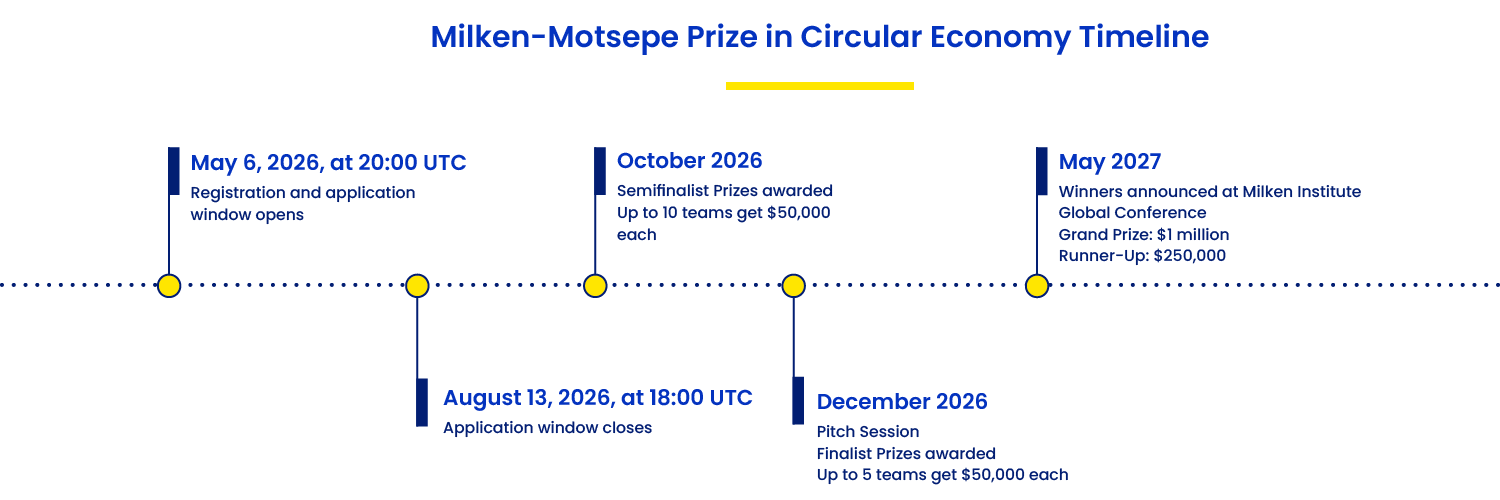
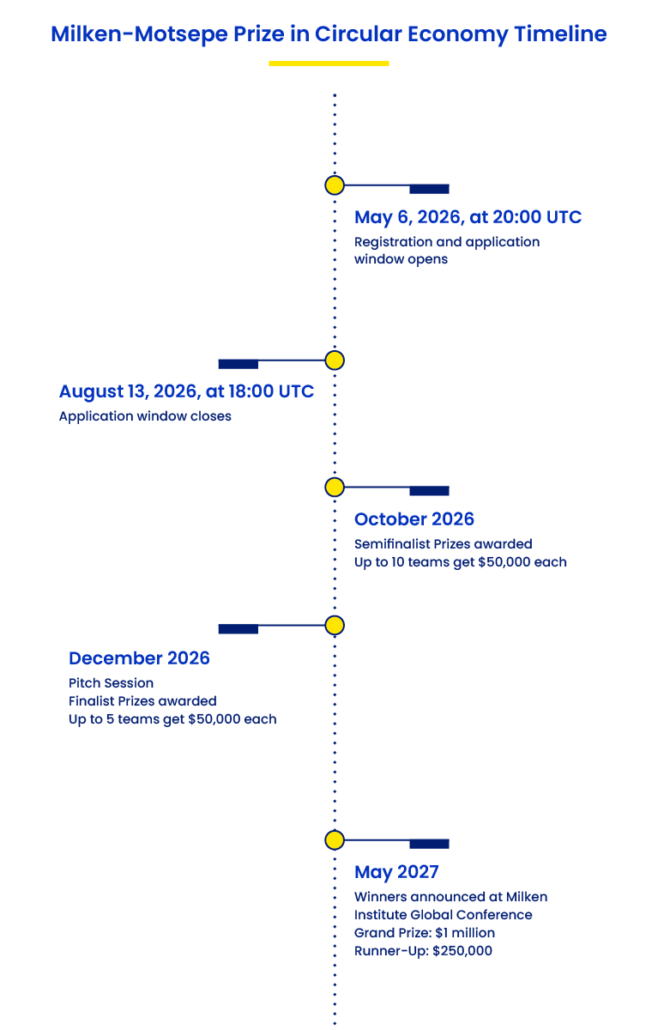
Teams submit their designs and business models. Ten teams will advance in the prize as semifinalists and receive $50,000.
Semifinalists will pitch their innovations to industry leaders and decision-makers. A panel of judges will select five teams to advance as Finalists and receive $50,000 each.
Finalist companies will submit materials for the grand prize submission (sign into the Prize Portal to view the full rules). The winning team will receive $1 million and the runner-up will receive $250,000.
Team Lead: Louisa Gathecha
Based in Kenya, Bottle Logistics East Africa is a technology-enabled circular economy company that combines digital reverse logistics with advanced industrial glass recovery infrastructure to collect, recover, recycle, reuse, and upcycle discarded glass into returnable packaging, high-quality glass cullet and value-added circular products.
Team Lead: Nnaemeka Ikegwuonu
Based in Nigeria, Cold Hubs designs, builds and operates 100 percent solar-powered walk-in cold rooms, refrigerated trucks, and reusable crates for outdoor food markets, fresh produce collection centers, and farm clusters to store and preserve perishable foods 24/7, extending their shelf life from 2 days to 21 days.
Team Lead: Avith Philip
Based in Tanzania, Country Materials is a tech-enabled circular steel company using AI and digital systems to identify, trace, and recover legitimate scrap metal and return it to productive use as raw material for Africa’s steel industry.
Team Lead: Kiros Teklu Berhe
Based in Ethiopia, EKT is a circular manufacturing company that transforms plastic waste into high-value products, creating jobs, reducing pollution, and building a scalable circular economy in Africa.
Team Leads: Ramy Azer and Heba Nayil
Based in Egypt and Australia, this engineering company has proven technology to convert banana plantation waste into environmentally sustainable and friendly biodegradable packaging and organic liquid fertilizer products.
Team Leads: Ani Vallabhaneni and David Auerbach
Based in Kenya, Regen Organics is building strong, resilient food systems for African farmers through a circular-economy model that converts polluting urban sanitation and organic waste into regenerative agricultural inputs, organic fertilizers, and biochar that restore soil, increase farmers’ incomes, and mitigate climate change.
Team Lead: Faith Kuya
SafeSip operates a dual-revenue circular economy model in Tanzania, converting post-consumer and agricultural plastic waste into ISO 4427 pressure-rated recycled resin and drip irrigation hardware, delivered to smallholder farmers as pay-per-liter Irrigation-as-a-Service with zero upfront capital outlay.
Team Lead: Samuel Rigu
Safi Organics is a Kenyan climate-tech company converting rice husks and sugarcane bagasse into Safi Sarvi®, a carbon-negative organic fertilizer that increases crop yields by up to 30 percent and farmer incomes by up to 50 percent.
Team Lead: Mahmoud Montash
Triple M is an Egyptian engineering company that uses diagnostic testing to extend the working life of electrical power infrastructure—purifying transformer oil and rehabilitating transformers, switchgear, and panels so that mineral oil, copper, and steel stay in service instead of becoming waste.
Team Lead: Bethelhem Dejene
Based in Ethiopia, Zafree Papers manufactures tree-free pulp and paper from agricultural residues, starting with banana farm waste, for the packaging industry.